

- Home
- MEDIA CENTER
- News
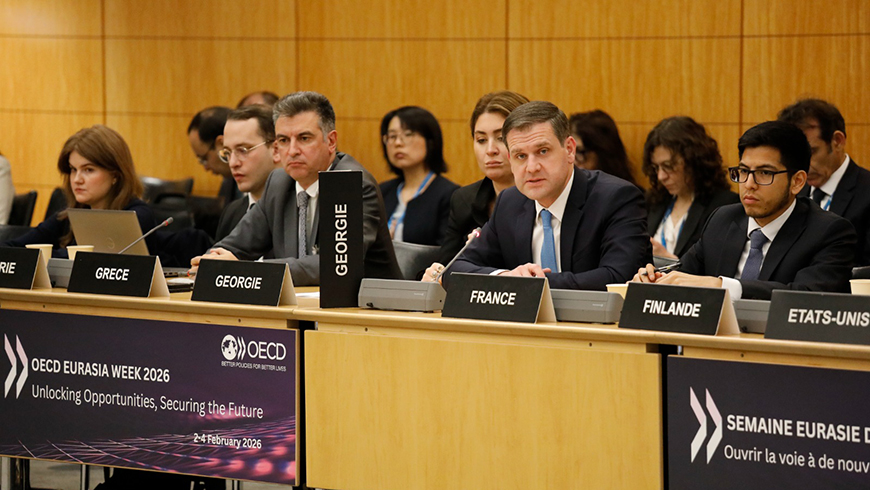
“Georgia continues its economic development by implementing structural reforms, including within the framework of the Deep and Comprehensive Free Trade Area agreement with the European Union, using trade and investment policy as an instrument for structural transformation. At this stage, Georgia has fulfilled 74% of the legislative approximation provided by the DCFTA” – Deputy Minister of Economy and Sustainable Development Genadi Arveladze stated in his speech at the plenary session of the OECD Eurasia Week, which was held in Paris, France.
As the Deputy Minister noted, Georgia has achieved significant progress in terms of bringing the national standardisation system into compliance with the European framework, both institutionally and in practice. As a result, the indicator for the adoption of European standards in Georgia has reached almost 95%, distinguishing the country among the countries of the region. According to Genadi Arveladze, the high level of harmonisation reduces technical barriers to trade and increases the ability of Georgian manufacturers to be competitive and integrate into European and global value chains.
“Georgia maintains one of the most liberal and predictable trade regimes in the region, creating a solid foundation for long-term investment. Our trade policy is characterised by low tariffs, minimal customs barriers, simplified procedures, and transparent, rules-based governance. A main priority is the diversification of both export markets and export products, which strengthens economic resilience and reduces dependency risks for investors” – Genadi Arveladze noted and highlighted that Georgian products enjoy preferential access to markets of over 2,3 billion consumer, while Georgia presents itself as an efficient production and distribution hub connecting Europe, Asia, and the Middle East. “This effort reflects a clear strategic vision, which includes bringing trade policy into compliance with investment incentives, strengthening Georgia’s role in regional and global value chains, and ensuring access to ever-growing, predictable and rules-based markets for investors” – Genadi Arveladze added.
The Deputy Minister also participated in panel discussions concerning support for small and medium-sized businesses and digitalisation. As Genadi Arveladze stated, to address the challenges facing small and medium-sized enterprises, particularly in rural and underserved regions, the government is implementing the state internetization program through the “Log-In Georgia” project, which provides for the installation of high-speed broadband infrastructure in so-called “white zones”, the settlements where commercial initiatives are limited. Genadi Arveladze noted that for small and medium-sized enterprises located beyond large urban centres, this means direct access to online markets, digital public services and cross-border trade opportunities.
According to the Deputy Minister, the OECD study “Promoting Business Development and Digitalisation in Georgia” was prepared in cooperation with the Ministry of Economy and Sustainable Development. It identifies challenges and includes recommendations for strengthening the digital transformation of small and medium-sized enterprises. Genadi Arveladze highlighted that the recommendation given in the study regarding the development of the “Digital Economy Development Strategy 2030” and the corresponding action plan has already been fulfilled.
OECD Eurasia Week was being held in Paris, France, and covered various sectors of the economy. Deputy Minister of Economy and Sustainable Development, Tamar Ioseliani also participated in the week’s events, speaking in one of the discussions about strengthening Georgia’s function in the process of Middle Corridor development.
OECD Eurasia Week is an annual high-level event involving heads of government agencies from member countries of the Organisation for Economic Co-operation and Development, as well as from the states of Central Asia and the South Caucasus.


- SERVICES
- Inventory of Licenses and Permits
- Tourism
- Communication, Information and Modern Technologies
- National Quality Infrastructure
- ECONOMIC POLICY
- SME Development Strategy of Georgia
- Foreign Trade
- Energy
- Transport
- Communications, Information and Modern Technologies
1403
2 99 11 11
2 99 11 61
2 99 11 70